

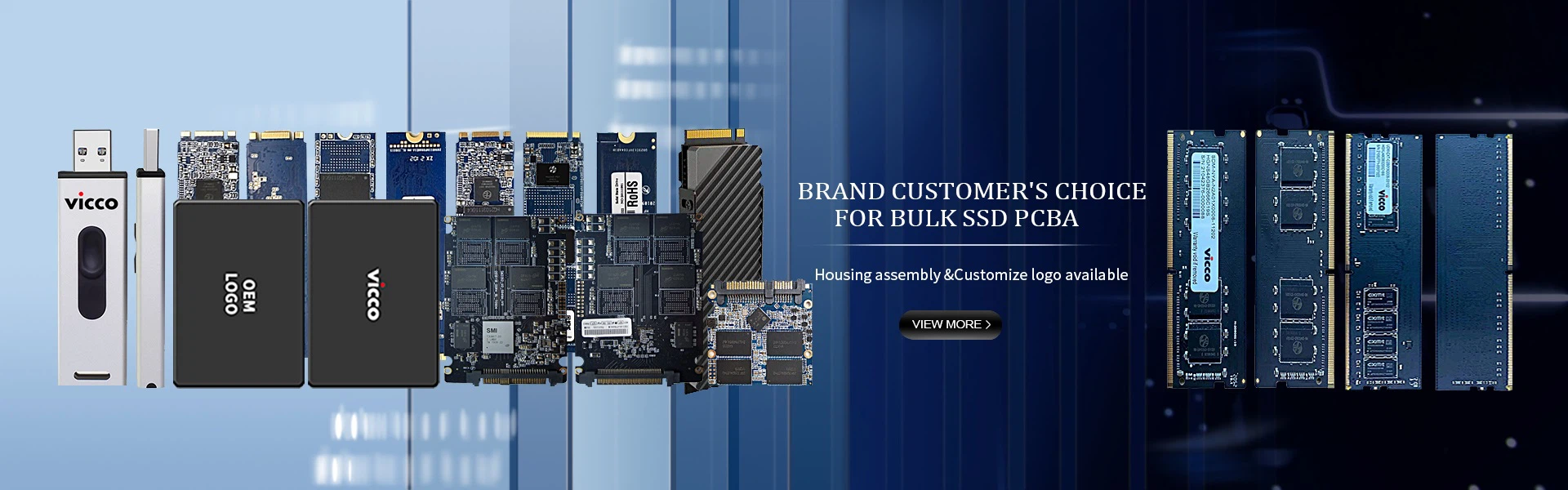


NEW M.2 PCIE NVME SSD 256GB 512GB 1T 2T HG2283+HYNIX V7
M.2 2280 S2 NVME SSD HG2283+ Hynix V7 1.PRODUCT SPECIFICATIONS Capacity − 128GB, 256GB, 512GB, 1024GB, 2048GB − Support 32-bit addressing mode Electrical/Physical Interface − PCIe Interface − Compliant with NVMe 1.3 − PCIe Express Base Ver 3.1 − PCIe Gen 3 x 4 lane & backward compatible to...
M.2 2280 S2 NVME SSD HG2283+ Hynix V7
1.PRODUCT SPECIFICATIONS
Capacity
− 128GB, 256GB, 512GB, 1024GB, 2048GB
− Support 32-bit addressing mode
Electrical/Physical Interface
− PCIe Interface
− Compliant with NVMe 1.3
− PCIe Express Base Ver 3.1
− PCIe Gen 3 x 4 lane & backward compatible to PCIe Gen 2 and Gen 1
− Support up to QD 128 with queue depth of up to 64K
− Support power management
Supported NAND Flash
− Support up to 16 Flash Chip Enables (CE) within a single design
− Support up to 4pcs of BGA132 flash
− Support 8-bit I/O NAND Flash
− Support Toggle2.0, Toggle3.0, ONFI 2.3, ONFI 3.0, ONFI 3.2 and ONFI 4.0 interface
Samsung V6 3D NAND
Hynix V7 3D NAND
ECC Scheme
− HG2283 PCIe SSD applies LDPC of ECC algorithm.
Sector Size Support
− 512B
− 4KB
UART/ GPIO
Support SMART and TRIM commands
LBA Range
− IDEMA standard
Performance
Performance of HG2283+Hynix V7 (1200Mbps)
|
Capacity |
Flash Structure (BGA Package) |
CE# |
Flash Type |
Sequential (CDM) |
IOMeter |
||
|
Read (MB/s) |
Write (MB/s) |
Read (IOPS) |
Write (IOPS) |
||||
|
128GB |
DDP x 1 |
2 |
BGA132, Hynix V7 |
1650 |
1100 |
195K |
260K |
|
256GB |
DDP x 2 |
4 |
BGA132, Hynix V7 |
3100 |
1850 |
360K |
450K |
|
512GB |
QDP x 2 |
8 |
BGA132, Hynix V7 |
3100 |
2090 |
360K |
475K |
|
1024GB |
QDP x 4 |
16 |
BGA132, Hynix V7 |
3100 |
2200 |
360K |
480K |
|
2048GB |
ODP x 4 |
16 |
BGA132, Hynix V7 |
3100 |
2200 |
360K |
480K |
NOTES:
1. Performance was based on Hynix V7 TLC NAND flash.
POWER CONSUMPTION
|
Capacity |
Flash Configuration (BGA Package) |
|
Power Consumption3 |
|
|
|
Read (mW) |
Write (mW) |
PS3 (mW) |
PS4 (mW) |
||
|
128GB |
DDP x 1 |
2940 |
2530 |
50 |
5 |
|
256GB |
DDP x 2 |
4120 |
3400 |
50 |
5 |
|
512GB |
QDP x 2 |
4090 |
3390 |
50 |
5 |
|
1024GB |
QDP x 4 |
4050 |
3380 |
50 |
5 |
|
2048GB |
ODP x 4 |
4440 |
3810 |
50 |
5 |
NOTES:
1. Data measured based on Hynix V7 512Gb mono die TLC Flash.
2. Power consumption is measured during the sequential read and write operations performed by IOMeter.
Flash Management
1.4.1. Error Correction Code (ECC)
Flash memory cells will deteriorate with use, which might generate random bit errors in the stored data. Thus, HG2283 PCIe SSD applies the LDPC (Low Density Parity Check) of ECC algorithm, which can detect and correct errors occur during read process, ensure data been read correctly, as well as protect data from corruption.
1.4.2. Wear Leveling
NAND flash devices can only undergo a limited number of program/erase cycles, when flash media is not used evenly, some blocks get updated more frequently than others and the lifetime of device would be reduced significantly. Thus, wear leveling is applied to extend the lifespan of NAND flash by evenly distributing write and erase cycles across the media.
HosinGlobal provides advanced wear leveling algorithm, which can efficiently spread out the flash usage through the whole flash media area. Moreover, by implementing both dynamic and static wear leveling algorithms, the life expectancy of the NAND flash is greatly improved.
1.4.3. Bad Block Management
Bad blocks are blocks that do not function properly or contain more invalid bits causing stored data unstable, and their reliability is not guaranteed. Blocks that are identified and marked as bad by the manufacturer are referred to as “Early Bad Blocks”. Bad blocks that are developed during the lifespan of the flash are named “Later Bad Blocks”. HosinGlobal implements an efficient bad block management algorithm to detect the factory-produced bad blocks and manages bad blocks that appear with use. This practice prevents data being stored into bad blocks and further improves the data reliability.
1.4.4. TRIM
TRIM is a feature which helps improve the read/write performance and speed of solid state drives (SSD). Unlike hard disk drives (HDD), SSDs are not able to overwrite existing data, so the available space gradually becomes smaller with each use. With the TRIM command, the operating system can inform the SSD so that blocks of data that are no longer in use can be removed permanently. Thus, the SSD will perform the erase action, which prevents unused data from occupying blocks at all time.
1.4.5. SMART
SMART, an acronym for Self-Monitoring, Analysis and Reporting Technology, is an open standard that allows a solid state drive to automatically detect its health and report potential failures. When a failure is recorded by SMART, users can choose to replace the drive to prevent unexpected outage or data loss. Moreover, SMART can inform users impending failures while there is still time to perform proactive actions, such as save data to another device.
1.4.6. Over-Provision
Over Provisioning refers to the preserving additional area beyond user capacity in a SSD, which is not visible to users and cannot be used by them. However, it allows a SSD controller to utilize additional space for better performance and WAF. With Over Provisioning, the performance and IOPS (Input/Output Operations per Second) are improved by providing the controller additional space to manage P/E cycles, which enhances the reliability and endurance as well. Moreover, the write amplification of the SSD becomes lower when the
controller writes data to the flash.
1.4.7. Firmware Upgrade
Firmware can be considered as a set of instructions on how the device communicates with the host. Firmware will be upgradable when new features are added, compatibility issues are fixed, or read/write performance gets improved.
1.4.8. Thermal Throttling
The purpose of thermal throttling is to prevent any components in a SSD from over-heating during read and write operations. HG2283 is designed with an on-die thermal sensor and with its accuracy; firmware can apply different levels of throttling to achieve the purpose of protection efficiently and proactively via SMART reading.
1.5. Advanced Device Security Features
1.5.1. Secure Erase
Secure Erase is a standard NVMe format command and will write all “0x00” to fully wipe all the data on hard drives and SSDs. When this command is issued, SSD controller will erase its storage blocks and return to its factory default settings.
1.5.2. Crypto Erase
Crypto Erase is a feature that erases all data of an OPAL-activated SSD or a “SED” (Security-Enabled Disk) drive by resetting the cryptographic key of the disk. Since the key is modified, the previously encrypted data will become useless, achieving the purpose of data security.
1.5.3. Physical Presence SID (PSID)
Physical Presence SID (PSID) is defined by TCG OPAL as a 32-character string and the purpose is to revert SSD back to its manufacturing setting when the drive is still OPAL-activated. PSID code can be printed on a SSD label when an OPAL-activated SSD supports PSID revert feature.
1.6. SSD Lifetime Management
1.6.1. Terabytes Written (TBW)
TBW (Terabytes Written) is a measurement of SSDs’ expected lifespan, which represents the amount of data
written to the device. To calculate the TBW of a SSD, the following equation is applied:
TBW = [(NAND Endurance) x (SSD Capacity)] / [WAF]
NAND Endurance: NAND endurance refers to the P/E (Program/Erase) cycle of a NAND flash.
SSD Capacity: The SSD capacity is the specific capacity in total of a SSD.
WAF: Write Amplification Factor (WAF) is a numerical value representing the ratio between the amount of data that a SSD controller needs to write and the amount of data that the host’s flash controller writes. A better WAF, which is near 1, guarantees better endurance and lower frequency of data written to flash memory.
TBW in this document is based on JEDEC 218/219 workload.
1.6.2. Media Wear Indicator
Actual life indicator reported by SMART Attribute byte index [5], Percentage Used, recommends User to replace drive when reaching to 100%.
1.6.3. Read Only Mode (End of Life)
When drive is aged by cumulated program/erase cycles, media worn-out may cause increasing numbers of later bad block. When the number of usable good blocks falls outside a defined usable range, the drive will notify Host through AER event and Critical Warning to enter Read Only Mode to prevent further data corruption. User should start to replace the drive with another one immediately.
1.7. Adaptive Approach to Performance Tuning
1.7.1. Throughput
Based on the available space of the disk, HG2283 will regulate the read/write speed and manage the performance of throughput. When there still remains a lot of space, the firmware will continuously perform read/write action. There is still no need to implement garbage collection to allocate and release memory, which will accelerate the read/write processing to improve the performance. Contrarily, when the space is going to be used up, HG2283 will slow down the read/write processing, and implement garbage collection to release memory. Hence, read/write performance will become slower.
1.7.2. Predict & Fetch
Normally, when the Host tries to read data from the PCIe SSD, the PCIe SSD will only perform one read action after receiving one command. However, HG2283 applies Predict & Fetch to improve the read speed. When the host issues sequential read commands to the PCIe SSD, the PCIe SSD will automatically expect that the following will also be read commands. Thus, before receiving the next command, flash has already prepared the data. Accordingly, this accelerates the data processing time, and the host does not need to wait so long to receive data.
1.7.3. SLC Caching
HG2283’s firmware design currently adopts dynamic caching to deliver better performance for better endurance and consumer user experience.
3.1. Environmental Conditions 3.1.1. Temperature and Humidity
Table 3-1 High Temperature
|
|
Temperature |
Humidity |
|
Operation |
70°C |
0% RH |
|
Storage |
85°C |
0% RH |
Table 3-2 Low Temperature
|
|
Temperature |
Humidity |
|
Operation |
0°C |
0% RH |
|
Storage |
-40°C |
0% RH |
Table 3-3 High Humidity
|
|
Temperature |
Humidity |
|
Operation |
40°C |
90% RH |
|
Storage |
40°C |
93% RH |
Table 3-4 Temperature Cycling
|
|
Temperature |
|
Operation |
0°C |
|
70°C1 |
|
|
Storage |
-40°C |
|
85°C |
Notes:
1. The operation temperature is measured by the case temperature, in which can be decided via the S.M.A.R.T. Airflow is suggested and it will allow device to be operated at appropriate temperature for each component during heavy workloads environment.
3.1.2. Shock
Table 3-5 Shock
|
|
Acceleration Force |
|
Non-operational |
1500G |
3.1.3. Vibration
Table 3-6 Vibration
|
|
Cond |
ition |
|
Frequency/Displacement |
Frequency/Acceleration |
|
|
Non-operational |
20Hz~80Hz/1.52mm |
80Hz~2000Hz/20G |
3.1.4. Drop
Table 3-7 Drop
|
|
|
Height of Drop |
|
|
Number of Drop |
|
Non-operational |
|
80cm free fall |
|
|
6 face of each unit |
|
3.1.5. Bending |
Table 3-8 Bending |
|
|
||
|
|
|
Force |
|
|
Action |
|
Non-operational |
|
≥ 20N |
|
|
Hold 1min/5times |
|
3.1.6. Torque |
Table 3-9 Torque |
|
|
||
|
|
|
Force |
|
|
Action |
|
Non-operational |
|
0.5N-m or ±2.5 deg |
|
|
Hold 1min/5times |
|
3.1.7. Electrostatic Discharge (ESD) |
Table 3-10 ESD |
|
|
||
|
Specification |
|
|
+/- 4KV |
|
|
|
EN 55024, CISPR 24 EN 61000-4-2 and IEC 61000-4-2 |
Device functions are affected, but EUT will be back to its normal or operational state automatically. |
||||
4. ELECTRICAL SPECIFICATIONS
4.1. Supply Voltage
Table 4-1 Supply Voltage
|
Parameter |
Rating |
|
Operating Voltage |
Min = 3.14 V Max = 3.47 V |
|
Rise Time (Max/Min) |
10 ms / 0.1 ms |
|
Fall Time (Max/Min) |
1500 ms / 1 ms |
|
Min. Off Time1 |
1500 ms |
NOTE:
1. Minimum time between power removed from SSD (Vcc < 100 mV) and power re-applied to the drive.
4.2. Power Consumption
Table 4-2 Power Consumption in mW
|
Capacity |
Flash Configuration |
CE# |
Read (Max) |
Write (Max) |
Read (Avg.) |
Write (Avg.) |
|
128GB |
DDP x 1 |
2 |
3200 |
2930 |
2940 |
2530 |
|
256GB |
DDP x 2 |
4 |
4650 |
4560 |
4120 |
3400 |
|
512GB |
QDP x 2 |
8 |
5260 |
4190 |
4090 |
3390 |
|
1024GB |
QDP x 4 |
16 |
5350 |
6070 |
4050 |
3380 |
|
2048GB |
ODP x 4 |
16 |
6320 |
6650 |
4440 |
3810 |
NOTES:
Based on APF1Mxxx-series under ambient temperature.
The average value of power consumption is achieved based on 100% conversion efficiency.
The measured power voltage is 3.3V.
The temperature of a storage device in PS1 should remain constant or should slightly decrease for all workloads so the actual power in PS1 should be lower than PS0.
The temperature of a storage device in PS2 should decrease sharply for all workloads so the actual power in PS2 should be lower than PS1.
5. INTERFACE
5.1. Pin Assignment and Descriptions
Table 5-1 defines the signal assignment of the internal NGFF connector for SSD usage, described in the PCI Express M.2 Specification version 1.0 of the PCI-SIG.
Table 5-1 Pin Assignment and Description of HG2283 M.2 2280
|
Pin No. |
PCIe Pin |
Description |
|
1 |
GND |
CONFIG_3 = GND |
|
2 |
3.3V |
3.3V source |
|
3 |
GND |
Ground |
|
4 |
3.3V |
3.3V source |
|
5 |
PETn3 |
PCIe TX Differential signal defined by the PCI Express M.2 spec |
|
6 |
N/C |
No connect |
|
7 |
PETp3 |
PCIe TX Differential signal defined by the PCI Express M.2 spec |
|
8 |
N/C |
No connect |
|
9 |
GND |
Ground |
|
10 |
LED1# |
Open drain, active low signal. These signals are used to allow the add-in card to provide status indicators via LED devices that will be provided by the system. |
|
11 |
PERn3 |
PCIe RX Differential signal defined by the PCI Express M.2 spec |
|
12 |
3.3V |
3.3V source |
|
13 |
PERp3 |
PCIe RX Differential signal defined by the PCI Express M.2 spec |
|
14 |
3.3V |
3.3V source |
|
15 |
GND |
Ground |
|
16 |
3.3V |
3.3V source |
|
17 |
PETn2 |
PCIe TX Differential signal defined by the PCI Express M.2 spec |
|
18 |
3.3V |
3.3V source |
|
19 |
PETp2 |
PCIe TX Differential signal defined by the PCI Express M.2 spec |
|
20 |
N/C |
No connect |
|
21 |
GND |
Ground |
|
22 |
N/C |
No connect |
|
23 |
PERn2 |
PCIe RX Differential signal defined by the PCI Express M.2 spec |
|
24 |
N/C |
No connect |
|
25 |
PERp2 |
PCIe RX Differential signal defined by the PCI Express M.2 spec |
|
26 |
N/C |
No connect |
|
27 |
GND |
Ground |
|
28 |
N/C |
No connect |
|
29 |
PETn1 |
PCIe TX Differential signal defined by the PCI Express M.2 spec |
|
30 |
N/C |
No connect |
|
31 |
PETp1 |
PCIe TX Differential signal defined by the PCI Express M.2 spec |
|
32 |
GND |
Ground |
|
33 |
GND |
Ground |
|
34 |
N/C |
No connect |
|
35 |
PERn1 |
PCIe RX Differential signal defined by the PCI Express M.2 spec |
|
36 |
N/C |
No connect |
|
37 |
PERp1 |
PCIe RX Differential signal defined by the PCI Express M.2 spec |
|
Pin No. |
PCIe Pin |
Description |
|
38 N/C |
No connect |
|
|
39 GND |
Ground |
|
|
40 SMB_CLK (I/O)(0/1.8V) |
SMBus Clock; Open Drain with pull-up on platform |
|
|
41 |
PETn0 |
PCIe TX Differential signal defined by the PCI Express M.2 spec |
|
42 |
SMB_DATA (I/O)(0/1.8V) |
SMBus Data; Open Drain with pull-up on platform. |
|
43 |
PETp0 |
PCIe TX Differential signal defined by the PCI Express M.2 spec |
|
44 |
ALERT#(O) (0/1.8V) |
Alert notification to master; Open Drain with pull-up on platform; Active low. |
|
45 |
GND |
Ground |
|
46 |
N/C |
No connect |
|
47 |
PERn0 |
PCIe RX Differential signal defined by the PCI Express M.2 spec |
|
48 |
N/C |
No connect |
|
49 |
PERp0 |
PCIe RX Differential signal defined by the PCI Express M.2 spec |
|
50 |
PERST#(I)(0/3.3V) |
PE-Reset is a functional reset to the card as defined by the PCIe Mini CEM specification. |
|
51 |
GND |
Ground |
|
52 |
CLKREQ#(I/O)(0/3.3V) |
Clock Request is a reference clock request signal as defined by the PCIe Mini CEM specification; Also used by L1 PM Sub-states. |
|
53 |
REFCLKn |
PCIe Reference Clock signals (100 MHz) defined by the PCI Express M.2 spec. |
|
54 |
PEWAKE#(I/O)(0/3.3V) |
PCIe PME Wake. Open Drain with pull up on platform; Active Low. |
|
55 |
REFCLKp |
PCIe Reference Clock signals (100 MHz) defined by the PCI Express M.2 spec. |
|
56 |
Reserved for MFG DATA |
Manufacturing Data line. Used for SSD manufacturing only. Not used in normal operation. Pins should be left N/C in platform Socket. |
|
57 |
GND |
Ground |
|
58 |
Reserved for MFG CLOCK |
Manufacturing Clock line. Used for SSD manufacturing only. Not used in normal operation. Pins should be left N/C in platform Socket. |
|
59 |
Module Key M |
Module Key |
|
60 |
Module Key M |
|
|
61 |
Module Key M |
|
|
62 |
Module Key M |
|
|
63 |
Module Key M |
|
|
64 |
Module Key M |
|
|
65 |
Module Key M |
|
|
66 |
Module Key M |
|
|
67 |
N/C |
No connect |
|
68 |
SUSCLK(32KHz) (I)(0/3.3V) |
32.768 kHz clock supply input that is provided by the platform chipset to reduce power and cost for the module. |
|
69 |
NC |
CONFIG_1 = No connect |
|
70 |
3.3V |
3.3V source |
|
71 |
GND |
Ground |
|
72 |
3.3V |
3.3V source |
|
73 |
GND |
Ground |
|
74 |
3.3V |
3.3V source |
|
75 |
GND |
CONFIG_2 = Ground |
Form factor: M.2 2280 S2
Dimensions: 80.00mm (L) x 22.00mm (W) x 2.15mm (H)
|
View Direction |
Diagram |
|
Top |
 
|
|
Bottom |
|
|
View Direction |
Diagram |
|
Side |
|
|
|
|


Figure 7-1 Product Mechanical Diagram and Dimensions
8. APPLICATION NOTES
8.1. Wafer Level Chip Scale Packaging (WLCSP) Handling Precautions
There are a lot of components assembled on a single SSD device. Please handle the drive with care especially when it has any WLCSP (Wafer Level Chip Scale Packaging) components such as PMIC, thermal sensor or load switch. WLCSP is one of the packaging technologies that is widely adopted for making smaller footprints, but any bumps or scratches may damage those ultrasmall parts so gentle handling is strongly recommended.
 DO NOT DROP SSD
 INSTALL SSD WITH CARE
 TORE SSD IN A PROPER PACKAGE
8.2. M Key M.2 SSD Assembly Precautions
M Key M.2 SSD (Figure 1) is only compatible to M Key (Figure 2) socket. As shown in Use Case 2, misuse may cause severe damages to SSD including burn-out.
Figure 8-1 M Key M.2 Assembly Precautions

Hot Tags: new m.2 pcie nvme ssd 256gb 512gb 1t 2t hg2283+hynix v7, China new m.2 pcie nvme ssd 256gb 512gb 1t 2t hg2283+hynix v7, sata 3 solid state drive, micro sd to cf card adapter, mobile phone memory stick, sd media card reader, ssd hard disk 240gb, ssd external type c


Send Inquiry
