

Classification Of Solid State Drives
Aug 20, 2022
Classification method:
There are two kinds of storage media of solid-state disk, one is using flash memory (flash chip) as storage media, and the other is using dram as storage media. The latest is Intel's xpoint granular technology.
Flash based solid state drives:
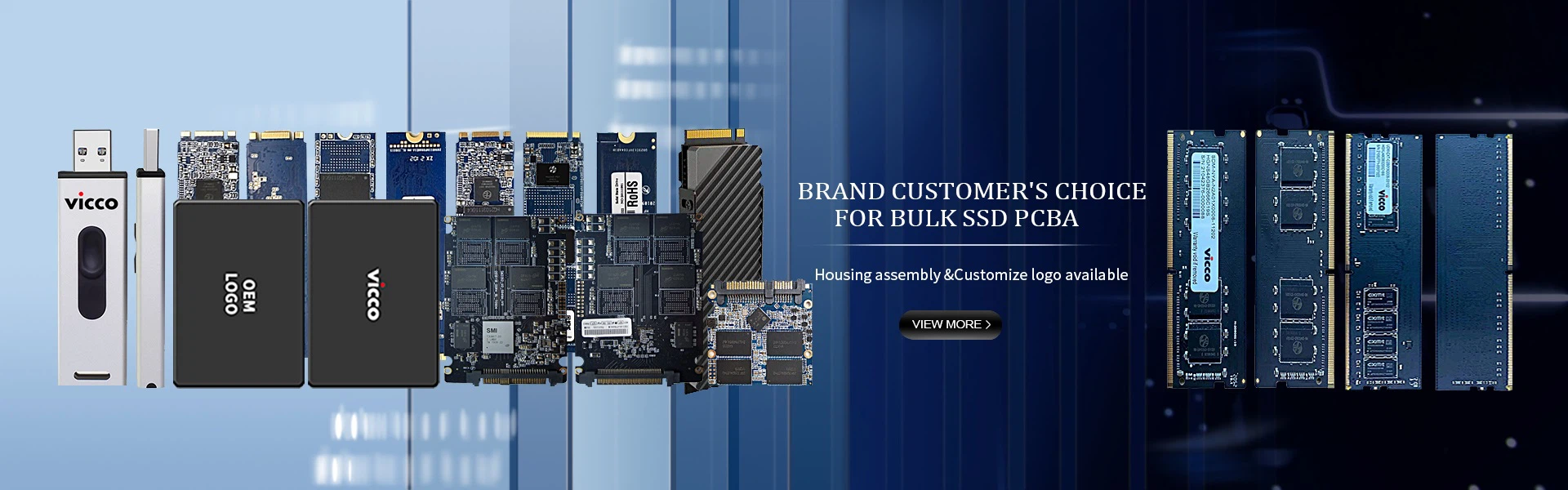
Flash based solid state disk (ideflash disk, serial ATA flash disk): flash chip is used as storage medium, which is also commonly known as SSD. Its appearance can be made into a variety of shapes, such as notebook hard disk, micro hard disk, memory card, U disk and other styles. The biggest advantage of this SSD solid-state disk is that it can be moved, and the data protection is not controlled by the power supply. It can be adapted to various environments and suitable for individual users. The service life is long and varies according to different flash media. SLC flash memory generally reaches tens of thousands of times of PE, MLC can reach more than 3000 times, TLC can also reach about 1000 times, and the latest QLC can also ensure a life of 300 times. The annual write volume of ordinary users does not exceed 50 times the total size of hard disks. Even the cheapest QLC flash memory can provide a 6-year write life. High reliability, high-quality household solid-state drives can easily reach one tenth of the failure rate of ordinary household mechanical hard drives.
Based on DRAM class:
Solid state disk based on DRAM: DRAM is used as the storage medium, with a narrow application range. It emulates the design of traditional hard disks, can be set and managed by file system tools of most operating systems, and provides industry standard PCI and FC interfaces for connecting hosts or servers. Application modes can be divided into SSD hard disk and SSD hard disk array. It is a high-performance memory, which can be written infinitely in theory. The shortcoming is that it needs an independent power supply to protect data security. DRAM solid state drives are relatively non mainstream devices. [1]
Based on 3D xpoint class
Solid state disk based on 3D xpoint: it is close to DRAM in principle, but it belongs to non-volatile storage. The read delay is extremely low, which can easily reach 1% of the existing solid-state disk, and has nearly unlimited storage life. The disadvantage is that the density is relatively low compared with NAND, and the cost is extremely high. It is mostly used for fever level desktop computers and data centers.


