

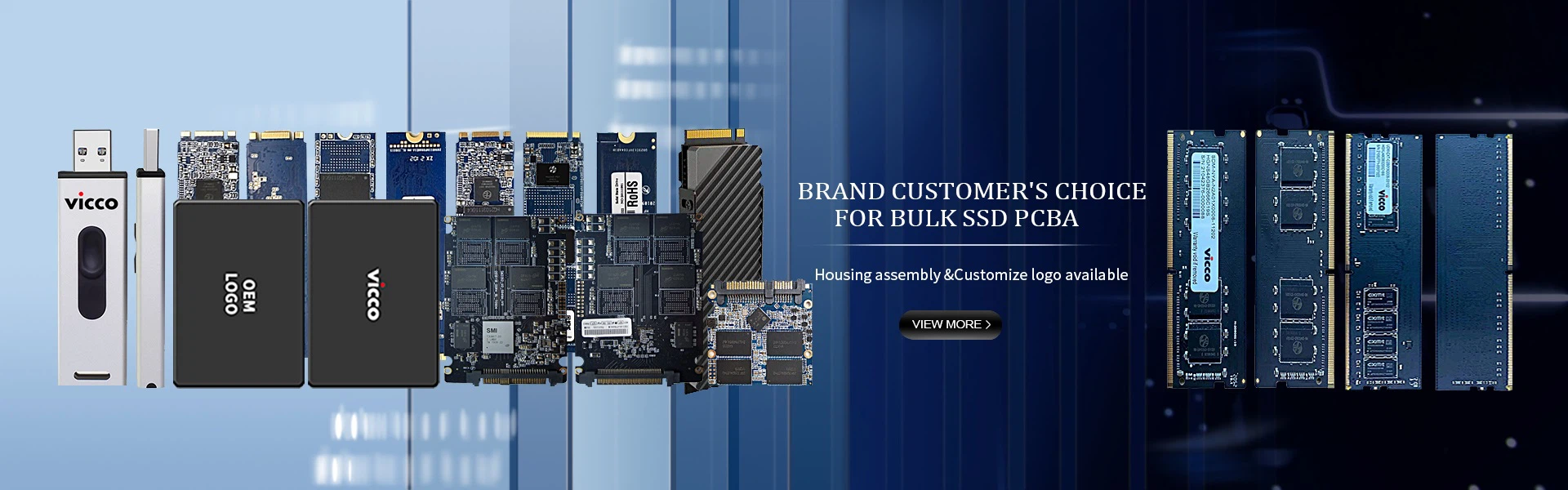
What are the types of solid state drives, the internal structure of solid state drives
Jul 25, 2023
There is no such type of solid state drive
(1) Points according to the interface
1. Connect to SATA 3.0
As the most common interface, SSDS using SATA 3.0 interface have a higher cost performance, and compared with the previous generation of SATA 2.0 interface, SATA 3.0 interface transfer speed of up to 6GB/S
2. MSATA interface
The MSATA interface is called the [MiniSATA] interface, and SSDS using this interface are much smaller in volume than SSDS with SATA 3.0 interface. Due to their size, SSDS with MSATA interfaces are often used for light and xanthorhoe notebooks, and their transmission speed and stability are no different from SATA 3.0 interface SSDS
3, M.2 pick up
M.2 interface SSD has the advantages of small size and sex. At present, the mainstream motherboard and M.2 interface SSD support PCLE 3.0x 4 channels, theoretical bandwidth up to 32Gbps, performance is very outstanding
4. PCI-E interface
PCLE interface SSD can only be used for desktop computers, it uses a direct connection through the bus and the CPU, has better performance than M.2 interface SSD, but the price is relatively high, the applicability is relatively low
In addition, SSDS also have SATA-express, SAS, U.2 and other interface types.
(2) According to the storage medium
One is the use of FLASH memory (FLASH chip) as the storage medium, the other is the use of DRAM as the storage medium solid state disk storage quality is divided into two new and Intel XPoint particle technology
1, flash-based solid state drive Flash-based solid state drive (IDEFLASH DISK, Serial ATA Flash Disk): the use of FLASH chip as the storage medium, which is also commonly referred to as SSD. Its appearance can be made into a variety of shapes, such as: notebook hard disk, micro hard disk, memory card, U disk and other styles. The biggest advantage of this SSD is that it can be moved, and data protection is not controlled by the power supply, can be adapted to a variety of environments, suitable for individual users, long life, high reliability, high-quality home SSD can easily reach the failure rate of ordinary home mechanical hard disk one tenth
2, based on DRAM class
DRAM based solid state drive: using DRAM as a storage medium, the application range is narrow. It emulates the design of traditional hard disks, can be set up and managed by the file system tools of most operating systems, and provides industry standard PCI and FC interfaces for connecting to hosts or servers. The application mode can be SSD disks and SSD disk arrays. It is a high-performance memory that can theoretically be written indefinitely, but the drawback is that it requires an independent power source to protect data security. DRAM solid-state drives are among the less mainstream devices.
3, based on 3D XPoint class
3D XPoint-based SSD: close to DRAM in principle, but non-volatile storage. Read latency is extremely low, easily up to one percent of existing SSDS, and has nearly unlimited storage life. The disadvantage is that the density is relatively low compared to NAND, the cost is extremely high, and it is mostly used in enthusiast-grade desktops and data centers.
The internal structure of a solid state drive
A simple sentence to summarize: solid state drive =PCB board + main control chip + cache particle + flash memory chip
The internal structure of the SSD is very simple, the main body of the SSD is actually a PCB board, and the most basic accessories on the PCB board are the control chip, the cache chip (some low-end hard disk cache chip) and the flash memory chip for storing data.
1, PCB board
Mainly responsible for the board components, external computer hardware for data interaction
2. Main control chip
The more common SSDS on the market are LSISandForce, Indilinx, JMicron, Marvell, Phison, Sandisk, Goldendisk, Samsung and intel and other main control chips. The main control chip is the brain of the SSD, and its role is to reasonably allocate the load of data on each flash memory chip, and the second is to assume the entire data transfer, connecting the flash memory chip and the external SATA interface. The capability difference between different masters is very large, the data processing capacity, algorithms, and the read and write control of the flash chip will be very different, which will directly lead to the performance gap of SSD products as high as several times.
3. Cache particles
The main control chip is next to the cache particle, SSD and traditional hard disk like smoke the high-speed cache chip to assist the main control chip for data processing. The cache particle capacity is much smaller than the flash particle on the same PCB board, but the read and write speed will be much faster, and the computer will generally preferentially use the cache particle for hard disk read and write. However, some cheap solid-state drive solutions in order to save costs, omit this cache chip, which will have a certain impact on the performance of use, especially the read and write performance and service life of small files.
4. Flash memory chip
In addition to the main control chip and cache chip, most of the remaining positions on the PCB board are NAND Flash flash memory chips. NAND Flash flash chips are divided into SLC (Single-Level Cel, single-layer unit), MLC (Multi-Level Cell, double-layer unit), TLC(Trinary Level Cell, TRinary Level Cell, TRinary level cell, Three layer Cell), QLC (Quad-Level Cell, four layer cell) such specifications.
There is also an eMLC(Enterprise Multi-Level Cel), an "enhanced" version of MLC NAND flash, which partially Bridges the performance and durability gap between SLC and MLC.


