

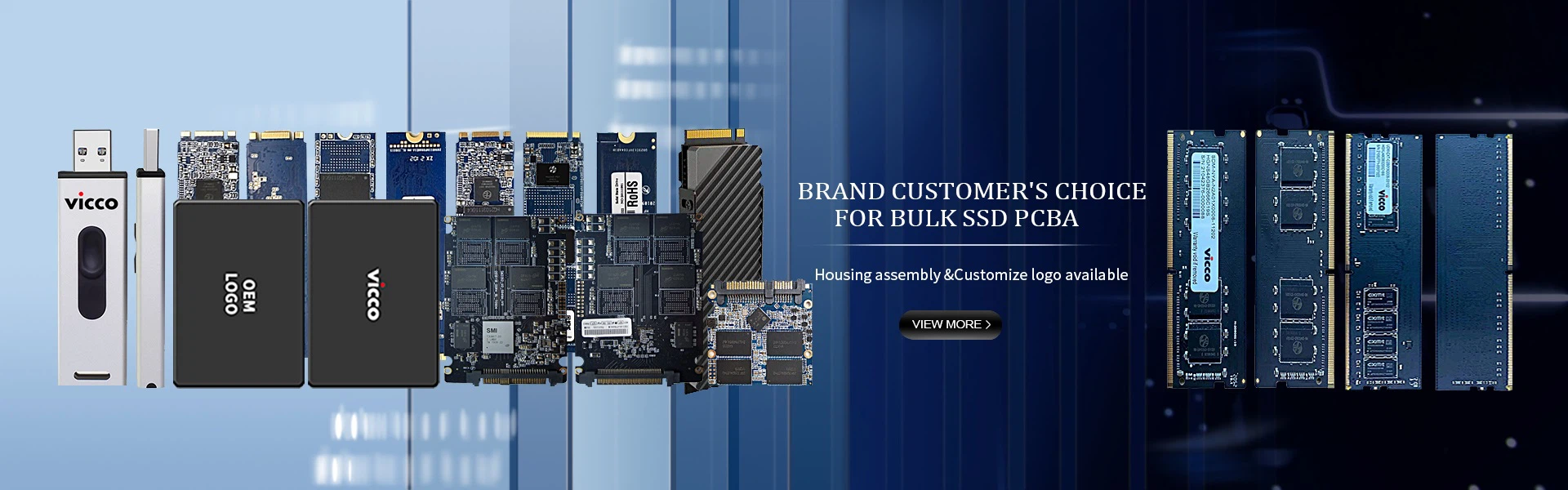
Advantages and disadvantages of solid state drive and its application
Aug 28, 2023
First, the basic principle of SSD
The storage principle of SSD is similar to that of U disk, using flash memory as the medium. Flash memory is composed of millions of capacitive memory chips, each chip is divided into multiple blocks. The data within each block can be modified at any time, but the entire block is either written or deleted. This means that the deletion operation leaves the entire block idle, and when new data is written, the entire block must be written. This results in slower write speeds and more times of storage in the flash memory. Therefore, the SSD's memory can only be written a certain number of times, after the number of writes is exhausted, the flash chip will become unusable.
Due to the difference in SSD storage media, its performance is better than traditional hard disks, and it is also more able to withstand the effects of mechanical vibration and temperature. In addition, SSD has the advantages of faster read speed, better response time and smaller size, so it is increasingly widely used in computers, mobile phones and other devices, as well as a variety of industrial and commercial applications.
Second, the advantages of SSD
1. Fast
SSDS have faster data read and write speeds because they have no mechanical parts and magnetic heads to move around reading and writing data. It can read and write much faster than traditional hard drives, improving computer speed, startup time and data transfer rates. For daily computer use, heavy work or gaming, the use of SSD is very necessary.
2. Save electricity
SSDS consume less power than traditional hard disks, so they are more convenient to use in some small computers and battery-powered devices. In addition, laptops that use SSDS are generally lighter and more portable than computers that use traditional hard drives.
3. Good stability
Because SSDS have no mechanical motion part, they have less impact on the computer's errors, especially vibration, than traditional hard drives. This allows SSDS to operate in various types of environments and conditions, which is particularly important for devices used in motor vehicles and other dynamic environments.
4. Permanent and reliable
Since SSDS have no moving mechanical parts inside them, they have no effect on the startup and shutdown time of the computer system. Also, because SSDS don't wear out over time, they last longer than traditional mechanical hard drives. In addition, because the SSD uses a flash memory chip, the data will not occur during the transmission process.
5. Small size
Compared to traditional hard drives, SSDS are much smaller in size and weight, which allows them to be loaded into small devices such as laptops, tablets, etc., and even small mechanical devices such as industrial controllers. Therefore, whether it is commercial or personal use, SSD is a very ideal choice.
Third, the shortcomings of SSD
1. The price is high
Compared with traditional hard drives, SSDS are expensive. This is because the internal curve of the flash chip is very different from that of traditional hard disks, and the storage capacity of SSDS is also smaller than that of traditional hard disks.
2. Life span is problematic
Due to the limit of the number of writes of the flash chip, there will always be problems with the life of the SSD, and the specific service life and specific life time still need to be verified by continuous experiments.
3. Insufficient capacity
Compared with traditional hard drives, SSD storage capacity is not large enough, so there are shortcomings in large-scale storage, and there are also some problems in the design, manufacturing and operation details.
4. Advantages of SSD in applications
Solid state drives are widely used in various fields because of their performance advantages. For example, in the fields of high-speed servers, e-commerce, data management, cluster computing, embedded applications, and ordinary home computers and mobile phones, SSDS can bring users a better experience and penetration. In addition, due to the high-speed response and high-quality formula of SSD in data transmission, it can also be widely used in other applications for various industries.
conclusion
In summary, solid-state drive has become an important new storage device because of its advantages of high speed reading and writing, low power consumption, small size and reliability. Compared with the traditional hard disk, although the SSD price is relatively high, write times limit, small storage capacity and other shortcomings are also inseparable from people's discussion and thinking, but with the continuous improvement and innovation of science and technology, I believe that the SSD will continue to be optimized in the future, so as to better meet the needs of users.


